


SPECIALTY CONTACT LENSES play an important role in eyecare practices and the lives of patients who require customized lenses to see and function. Innovation drives lens prescription—and research, case reports, and lectures allow practitioners to learn about lens options and techniques that make fitting these lenses rewarding.
Reports that show what lenses are most commonly prescribed and sold year to year can provide a picture of the direction in which innovation is driving lens prescription for the future.
In this report, the state of GP and specialty lens usage in 2026 has been derived from 2 sources: survey responses from practitioners who are members of the advisory board of the GP Lens Institute (GPLI) and a report from the Contact Lens Manufacturers Association (CLMA) on types of specialty lenses sold in the United States, based on aggregated data that has been collected since 2020.
Contact Lens Hot Topics
When questioned, members of the GPLI advisory board listed a large range of contact lens and ocular topics that they feel are the hot topics of 2026. The variety in their responses shows the breadth of the cornea and specialty contact lens field.
Topics of interest range from new corneal procedures for keratoconus—and when to fit lenses after these procedures—to lens-fitting strategies for practitioners who use all levels of technology in their practices. Correcting higher-order aberrations (HOAs) was listed most often as a hot topic in specialty lenses for 2026. Dry eye treatment with contact lenses, via either lens wear or using drug-delivery lenses, was also professed to be of great importance. Myopia management, corneal cross-linking, and using artificial intelligence (AI) for contact lens fitting were other topics deemed to be “hot” by this group of specialty lens fitters.
GP and Specialty Lens Trends
Results of the CLMA research conducted by an independent consulting group show an increase in nearly every category of specialty lenses since 2020. Although a large uptick in lenses fit between 2020 and 2021 is likely a result of fewer lenses fit during the early part of the COVID-19 pandemic, increases in lenses sold each year since that time reveal that specialty lens fitting is alive and well!
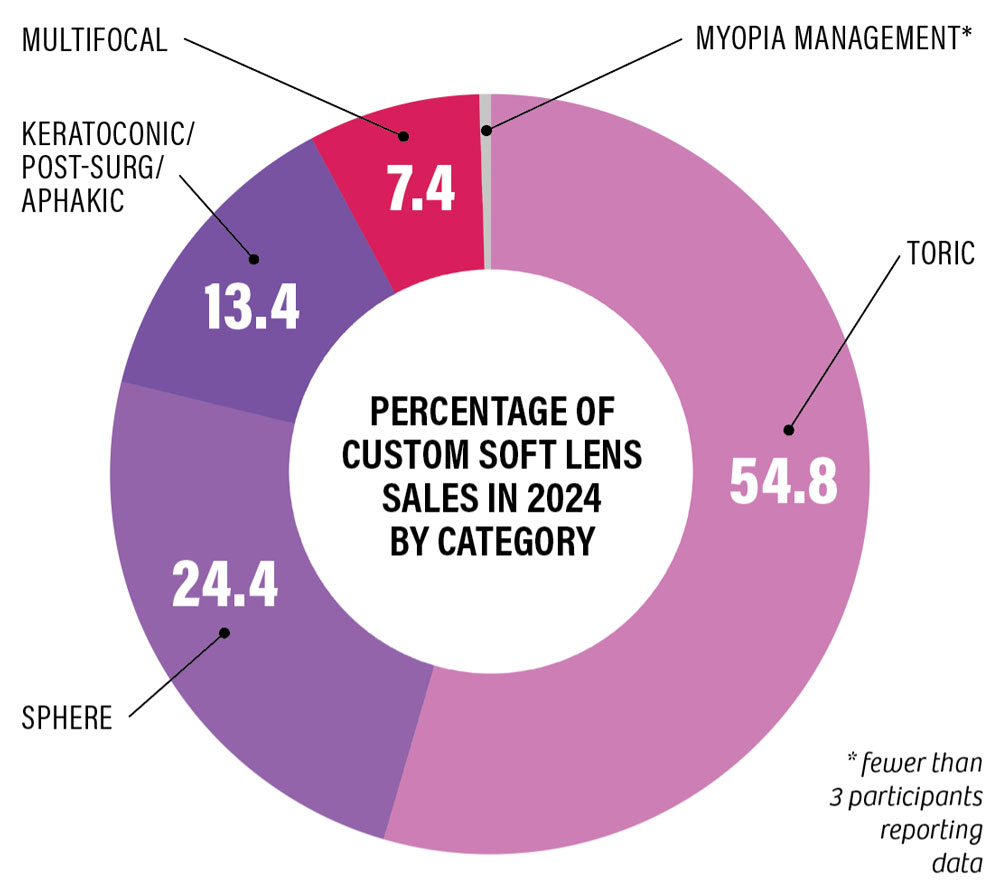
Surveys in 2015, 2020, and 2025 conducted by the Scleral Lenses in Current Ophthalmic Practice Evaluation (SCOPE) group have shown increases in the number of scleral lenses being fit over this time.1-3 However, the increase in corneal and soft specialty lenses sold annually since 2020 shows that scleral lens fitting may not be “stealing” from nonscleral fittings, as could be suspected. In addition to increases in the number of scleral lenses fit over the years of the report, growth also occurred in sales of nonscleral spherical and toric lenses and nonscleral lenses specifically designed for keratoconus. Soft custom lenses are most frequently used for astigmatism, and sales of multifocal and medically necessary lenses for keratoconus, aphakia, and postsurgical cases have shown growth over the years of the report (Figure 1).
Although nearly all modern contact lenses are “gas permeable,” the term is largely used to describe rigid lenses that allow oxygen to pass through. This is a great improvement compared to the historical rigid lenses made of polymethylmethacrylate (PMMA), which were known to cause corneal edema and hypoxia.4
Advances in the gas permeability of modern lenses have continued, and the results of the CLMA report show this clearly when lenses are categorized by oxygen permeability (Dk) (Table 1). Lens buttons sold to labs are reported, and the number of buttons made of low-Dk materials (less than 40 Dk) have remained stable since 2020. This is also true for medium-Dk lens materials (41-100 Dk). Sales of high-Dk lens materials (100-160 Dk) and hyper-Dk lens materials have both increased considerably over the years of the report.

Although these buttons are not broken down by their intended lens designs in the report, it is reasonable to assume that the popularity of scleral lenses is a reason for this increase. Because the overall oxygen permeability of a scleral lens includes both the Dk of the tears in the fluid reservoir and the Dk of the lens material, minimizing the lens thickness and using a high-Dk lens material can improve oxygen permeability of the entire lens system.5
Although the importance of maximizing Dk is not a new concept, the concerns among practitioners in this area persist. Comments in the GPLI advisory board survey listing include “new materials” and “strategies for maximizing oxygen delivery” as topics that are important in specialty lenses in 2026.
Scleral Lenses
Overall enthusiasm for scleral contact lenses was evident among the GPLI advisory board members completing the 2026 survey. Numerous members specifically noted the recent surge in HOA correction using scleral lenses and the use of scleral lenses in ocular surface disease as topics of high interest among practitioners. Unsurprisingly, annual scleral contact lens sales have shown growth each year included in the report. Overall, greater numbers of spherical scleral lenses are being sold compared to scleral lenses with toricity.
This finding differs from practitioner estimates of the scleral lenses they fit based upon the landing zone shape.6 A 2020 survey of 715 scleral lens fitters found that an average estimated 40% of the scleral lenses they fit used spherical landing zones compared to a mean estimate of 48% of lenses fit with toric landing zones.2
A difference in the practitioner estimates compared to sales reported may be a result of scleral lens practitioners who had more experience completing the survey, since a minimum of 5 scleral lens fits was required to participate.
The CLMA also reports sales of scleral lenses categorized by lens diameter (Table 2). Each year reported shows a consistent distribution of lenses by size. Approximately 75% to 80% of all scleral lenses sold over the years covered in the report were between 15.5 mm and 17.5 mm in diameter. Those between 13.4 mm and 15.4 mm comprised 16% to 18% of sales each year, and lenses with a diameter larger than 17.5 mm comprised 3% to 6% of total scleral lens sales.

Orthokeratology
Myopia control in children is a hot topic in many aspects of eye care—with practitioners who see children implementing treatment options ranging from low-dose atropine to soft contact lenses with multiple focal points to orthokeratology (ortho-k). Although many types of myopia control began as off-label treatment options, the US Food and Drug Administration has approved, granted de novo status, and approved marketing for myopia management for soft lenses, spectacles, and orthokeratology, respectively.
Although originally used by specialty contact lens fitters simply to provide clear vision for adults during the day after overnight wear, the myopia control effects of ortho-k lenses in young wearers of the lenses were discovered later and became the focus of extensive research. The expansion of ortho-k lens wear over the years has made this type of lens synonymous with myopia control, despite the fact that many adult patients still choose to wear them for the lens-free convenience they can provide.
These contact lenses were one of the earliest recognized myopia control treatments, and their popularity has not waned despite the introduction of numerous other treatment options for myopia. Responses to the GPLI advisory board survey identified ortho-k as a hot topic in 2026, stating that “ortho-k management and troubleshooting are of great importance,” and that “examining the ortho-k patient perspective on lens wear and vision correction is also vital” as parents explore options for myopia control.
Presbyopia
Contact lens fitting for presbyopia is largely underutilized so far. Fortunately, nonpresbyopic specialty lens wearers become great candidates for multifocal specialty lenses after the onset of presbyopia. Interestingly, not all patients are introduced to multifocal lenses. Results of a 2018-2022 international survey found that 46% of presbyopic contact lens wearers were wearing single-vision lenses, which were likely being supplemented with reading glasses.7 This means that there is a large opportunity for multifocal lens fitting among contact lens wearers.
Studies have shown that presbyopic patients have the same attitudes as nonpresbyopic patients toward contact lens wear,8 and practitioners should not assume that patients who are not yet wearing multifocal lenses are opposed to the idea of wearing them to correct vision at all distances in presbyopia. Although overall specialty multifocal lenses have not changed drastically since 2021, there has been an interesting shift within the category.
Scleral multifocal contact lens sales have seen an overall upward trend over the span of the report, with a 75% increase in annual sales between 2020 and 2024. Soft custom multifocal lens sales made a large jump in 2023 compared to 2022 and have continued to increase, albeit at a slower rate, since that time. Corneal lenses are the only specialty lenses that have not shown growth in the multifocal category over this period.
Contact Lenses for Keratoconus
The CLMA report shows that corneal GP lenses and soft custom lenses designed specifically for keratoconic eyes are holding strong as options in this category. This fact may be summed up best by a comment made in the GPLI board survey: “Corneal GP lenses aren’t dead.”
Determining the best contact lens design for a patient can be based on ocular factors, but patient lifestyle, history of previous lens wear, dexterity, and lifestyle are also important considerations. Studies comparing visual acuities with various designs have shown better acuities with GP designs compared to soft designs,9 although no significant differences have been found between scleral and corneal keratoconus lenses.10
Corneal lenses designed for keratoconus are available in numerous designs with multiple curves and asphericity, depending on the manufacturer.11 Difficulties with centration or discomfort can be alleviated with piggybacking if needed. Soft lenses for keratoconus may offer an individual better comfort than a rigid lenses, and multiple designs are available to optimize vision. Hybrid lenses are another option for eyes that have keratoconus, but sales are not reported by the CLMA, since lens categories with only 1 manufacturer are not included in the aggregated report.
The Future
There is no question that specialty contact lenses positively impact the lives of patients. These contact lenses are also impactful in the careers of practitioners who fit them, because they achieve satisfaction when witnessing improvements in their patients’ quality of life after lenses are fit. It is encouraging to see the results of the CLMA survey showing that specialty contact lenses are “alive” and thriving in our profession.
The evolution of specialty lenses is evident in the report, as the popularity of ortho-k contact lenses reflects the world’s desire to slow the progression of myopia and that of scleral lenses highlights the benefits of a large-diameter lens for keratoconus, ocular surface disease, and refractive correction of difficult prescriptions.
Additionally, comments from members of the GPLI advisory board provide enthusiasm for the future of specialty contact lenses. Observations regarding the recent explorations into HOA correction and drug delivery with the use of specialty lenses show the drive of practitioners to provide better outcomes for patients.
The evolution of specialty contact lenses is truly a partnership between visionary researchers, determined clinicians who dream of new ways to solve problems with lenses, and creative labs that make and improve upon them over time. And patients will continue to be the beneficiaries of this extraordinary collaboration.
References
1. Nau CB, Harthan J, Shorter E, et al. Demographic characteristics and prescribing patterns of scleral lens fitters: the SCOPE study. Eye Contact Lens. 2018;44 Suppl 1:S265-S272. doi: 10.1097/ICL.0000000000000399
2. Nau CB, Harthan JS, Shorter ES, et al. Trends in scleral lens fitting practices: 2020 scleral lenses in current ophthalmic practice evaluation survey. Eye Contact Lens. 2023;49(2):51-55. doi: 10.1097/ICL.0000000000000960
3. Harthan JS, Nau CB, Schornack M, Nau A, Fogt JS, Shorter E. Scleral Lens prescription and management practices: SCOPE practitioner 2025 survey. Invest Ophthamol Vis Sci. 2026;67(7):1735-1735.
4. 5 - Cornea. In: Kaiser PK, Friedman NJ, eds. The Massachusetts Eye and Ear Infirmary Illustrated Manual of Ophthalmology (Fourth Edition): W.B. Saunders; 2014:173-232.
5. Michaud L, van der Worp E, Brazeau D, Warde R, Giasson CJ. Predicting estimates of oxygen transmissibility for scleral lenses. Cont Lens Anterior Eye. 2012;35(6):266-271. doi: 10.1016/j.clae.2012.07.004
6. Schornack MM, Nau CB, Harthan J, Shorter E, Nau A, Fogt J. Current trends in scleral lens prescription, management, and evaluation. Eye Contact Lens. 2023;49(2):56-62. doi: 10.1097/ICL.0000000000000957
7. Morgan PB, Efron N, Papas E, et al. BCLA CLEAR presbyopia: management with contact lenses and spectacles. Cont Lens Anterior Eye. 2024:102158. doi: 10.1016/j.clae.2024.102158
8. Rueff EM, Bailey MD. Presbyopic and non-presbyopic contact lens opinions and vision correction preferences. Cont Lens Anterior Eye. 2017;40(5):323-328. doi: 10.1016/j.clae.2017.03.010
9. Kumar P, Bandela PK, Bharadwaj SR. Do visual performance and optical quality vary across different contact lens correction modalities in keratoconus? Cont Lens Anterior Eye. 2020;43(6):568-576. doi: 10.1016/j.clae.2020.03.009
10. Levit A, Benwell M, Evans BJW. Randomised controlled trial of corneal vs. scleral rigid gas permeable contact lenses for keratoconus and other ectatic corneal disorders. Cont Lens Anterior Eye. 2020;43(6):543-552. doi: 10.1016/j.clae.2019.12.007
11. Santodomingo-Rubido J, Carracedo G, Suzaki A, Villa-Collar C, Vincent SJ, Wolffsohn JS. Keratoconus: An updated review. Cont Lens Anterior Eye. 2022;45(3):101559. doi: 10.1016/j.clae.2021.101559