


CUSTOM SOFT CONTACT LENSES address multiple refractive, therapeutic, and rehabilitative needs when standard off-the-shelf lenses cannot provide adequate fit, optimal vision, or sufficient comfort. They occupy a unique position within the specialty contact lens spectrum, bridging the gap between conventional soft lenses and custom rigid lenses. For patients who require a higher degree of customization but are unable to tolerate or are not yet ready for a corneal GP or scleral lens, custom soft lenses offer an effective alternative. This article reviews the clinical conditions and patient populations that can benefit from custom soft contact lenses and suggests practical fitting strategies to maximize clinical success.
When patients present with high refractive errors or irregular corneas, many practitioners instinctively turn to corneal GP, hybrid, or scleral lens designs to maximize visual acuity and comfort. However, it is important not to overlook the wide range of custom soft contact lenses available today. Many of them are made to order using precision lathe-cutting technology, allowing for an exceptional level of customization. Because they are individually fabricated, production and delivery time are often required.
Custom soft lenses are an excellent option for patients who have high ametropia, astigmatic presbyopia, irregular corneas, or other complex visual needs and require specific parameters. They can also be designed with decentered optics, wavefront-guided optics, or myopia management features, making them a versatile solution for a number of clinical applications.
Custom Soft Contact Lens Indications
Custom soft lenses have many clinical applications and may be indicated for a wide range of patients, including individuals who have high ametropia (spherical and/or astigmatic), unusually large or small horizontal visible iris diameter (HVID), steep or flat corneal curvature, or those who have experienced failure with standard soft contact lenses. They are also appropriate for patients who are unable to tolerate rigid GP lenses. Additional indications include patients requiring simultaneous astigmatic and presbyopic correction, patients who have multifocal fitting limitations related to pupil size, or those suffering from inadequate vision or discomfort when wearing conventional multifocal designs.1,2
For patients who cannot successfully wear standard soft lenses due to limitations in comfort, vision, or fit, custom soft lenses offer a high degree of parameter flexibility. Sphere power can be specified in 0.1 D steps, and cylinder axis can be ordered in 1º increments. Additional design options for soft lenses include a wide range of base curves (BCs) and diameters, the incorporation of prism, modified lens thickness profiles, and adjustments to optic zone size.
Standard soft multifocal contact lenses offer limited customization. Manufacturers typically provide just one design, and only limited parameter changes are available within fitting sets. Custom soft multifocal lenses give practitioners the opportunity to tweak add power, optic zone size, and multifocal zone geometry.
Replacement schedule options for custom soft lenses vary by lens material and include monthly, quarterly, semiannual, or annual replacement. Due to extended-wear intervals in some designs, patients wearing lenses in this modality may be more susceptible to surface deposits, so appropriate lens care is essential. Multipurpose solutions and hydrogen peroxide systems are commonly recommended, and for cases of significant deposition, adjunctive cleaning choices such as enzymatic or alcohol-based cleaners may be considered.3,4
Custom soft lenses are particularly valuable for patients who have irregular corneas. Appropriate candidates include those who have high irregular astigmatism, post–refractive surgery ectasia, asymmetric keratoconus, early keratoconus, and intolerance to GP lenses, as well as those post corneal cross-linking and post corneal transplantation. Diagnostic fitting is strongly recommended in these cases. Patient education is essential, particularly regarding realistic expectations. Some reduction in visual acuity may be necessary in exchange for improved comfort and lens tolerance. Patients who have a history of refractive surgery may have especially high visual expectations, and refitting often requires additional chair time and follow-up.4
Several fitting principles are critical to managing irregular corneas with custom soft lenses. These lenses are typically thicker and, therefore, must demonstrate adequate movement on the eye (up to 2 mm). Minimal or absent movement is considered an unacceptable fit and may increase the risk of hypoxia and corneal edema. Many of these lens designs have a prominent optic zone (Figure 1), and observation of the optic zone during the blink may help determine adequate or inadequate movement. Material characteristics also vary between designs; some lenses are stiffer, while others may be more flexible or prone to adherence or inversion during removal.2

Soft prosthetic lenses: Custom soft lenses are also available for prosthetic indications (Figure 2). These designs may be used to reduce photophobia through light-filtering properties, for cosmetic enhancement, or for therapeutic and rehabilitative purposes. Prosthetic soft lenses are available in transparent enhancer tints with or without a clear pupil, opaque tints with full or partial iris coverage with or without a clear pupil, and combined systems incorporating both opaque and transparent layers in underprint or overlay configurations.4-6
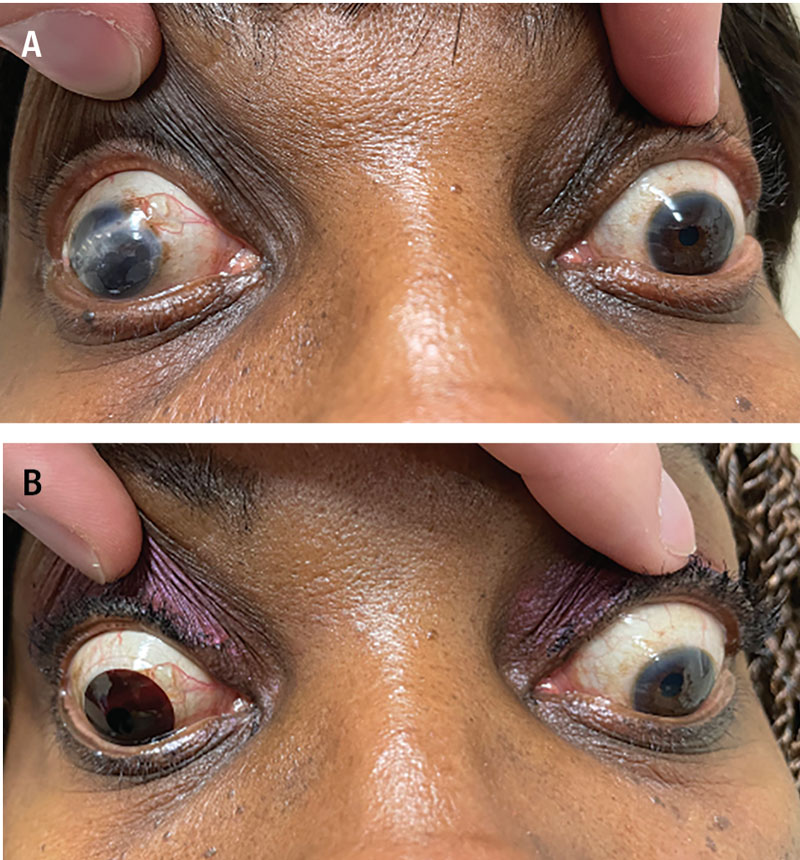
When fitting prosthetic lenses, careful attention must be given to patient counseling and expectation management. Key considerations include limitations in color matching, variability in cosmetic outcomes, and realistic functional improvement. Counseling should also include discussion with family members when appropriate, along with education on monocular precautions, including the importance of protective eyewear, if needed.
Fitting Strategies for All Custom Soft Lenses
As with conventional soft lens fitting, obtaining several key clinical measurements is essential when selecting an initial custom soft lens design and prescription, regardless of indication.7 A vertexed manifest refraction should be performed before initiating the fitting process, as it helps determine the appropriate lens design,8 such as a toric, multifocal, or specialty design intended to mask corneal irregularity. Keratometry or corneal topography/tomography should also be obtained to evaluate the magnitude and type of corneal astigmatism, providing additional guidance for lens selection.9
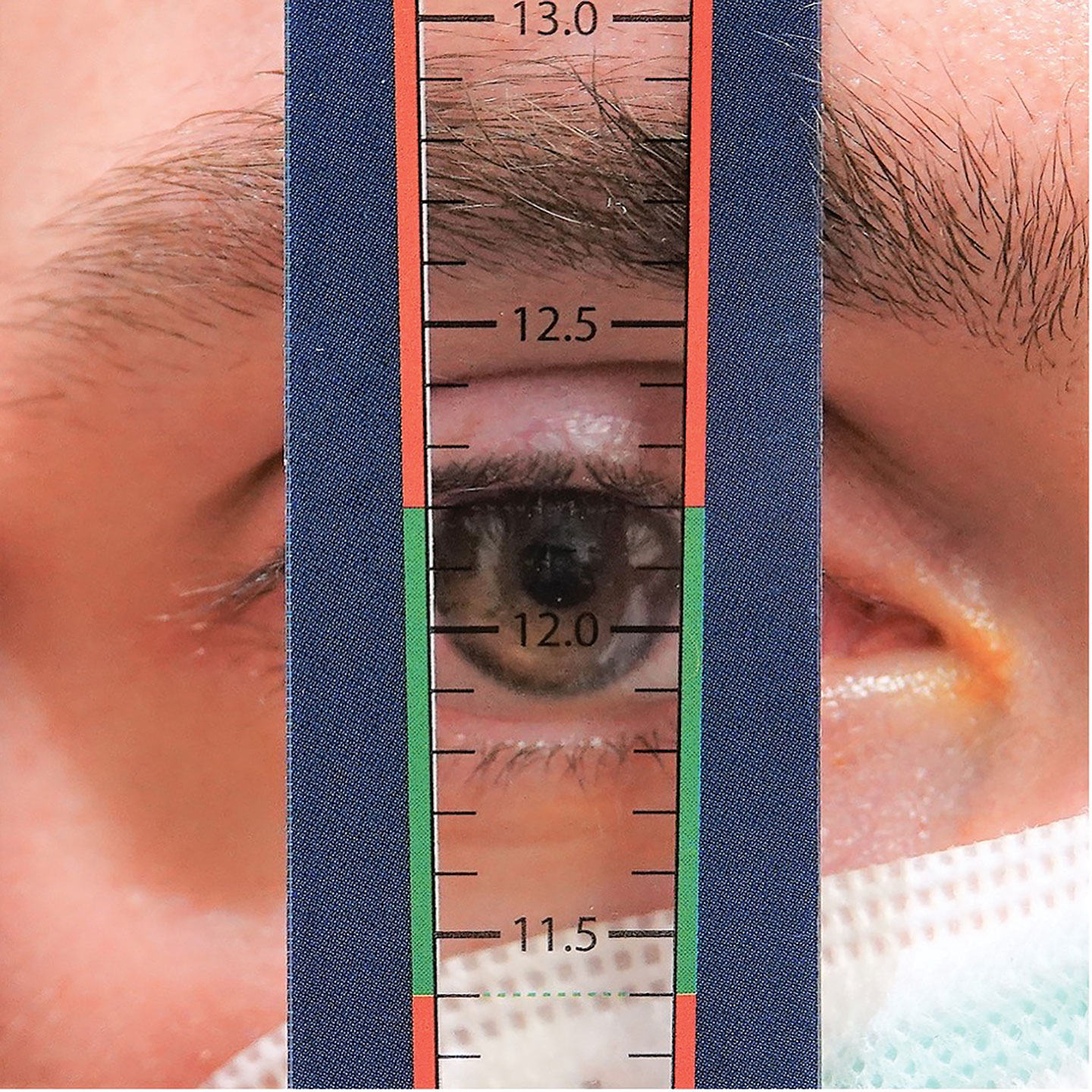
One of the most important measurements is the corneal diameter, or HVID, as it plays a critical role in determining the overall contact lens diameter and has the greatest influence on the sagittal depth of the lens.10 HVID can be measured using a variety of methods, including an HVID ruler (Figure 3), corneal topography or tomography, corneoscleral profilometry, anterior-segment optical coherence tomography, a pupillary distance ruler, or the reticule incorporated into the slit lamp. Many custom soft contact lens manufacturers use a sagittal depth (sag)-based fitting rather than relying solely on traditional BC and diameter selection. This approach aims to match the sagittal depth of the lens to the ocular sagittal height measured over a specified chord diameter.11 For example, an eye that has a smaller HVID generally has a shallower sagittal height, whereas a larger HVID is typically associated with a deeper sagittal height.12,13 This fitting method is especially valuable for patients who have irregular corneas, where conventional BC and diameter combinations often fail to provide an optimal fit.
The importance of sagittal depth was demonstrated by van der Worp and colleagues, who evaluated the sagittal depth of daily disposable, reusable, and toric soft contact lenses.14 Their study revealed considerable variation in lens sag among different lens designs, including lenses that had the same BC. They also showed that changing the BC alone can produce substantial differences in lens sag, potentially affecting lens fit. A difference of approximately 275 µm in lens sag was found to be clinically significant, highlighting the impact of selecting soft lenses based on BC alone.
The fitting process for custom soft lenses is generally straightforward; however, additional considerations are required when fitting patients who have irregular corneas or those requiring prosthetic lens designs. After collection of keratometric values, manifest refraction, HVID, add power (when indicated), and an accurate pupil size measurement, lenses can be ordered empirically through an online fitting system, using a diagnostic fitting set, or directly via manufacturer’s consultation, depending on the patient’s condition and the manufacturer’s recommendation. Depending on the degree of customization required, lens delivery typically ranges from 2 days to 2 weeks.15
Fitting custom soft lenses for patients who have irregular corneas, such as keratoconus or postsurgical corneal irregularity, requires additional clinical attention.16 Aberration-controlled designs, as well as reverse-geometry designs, are also available specifically for patients who have irregular corneas.17 When fitting these patients with custom soft contact lenses, a dynamic assessment approach is commonly used. Because these lenses are typically thicker to mask corneal irregularity, adequate lens movement is necessary not only to ensure proper tear exchange, but also to improve comfort.15
When fitting a custom soft lens on an eye that has irregular astigmatism, the initial evaluation should include refraction, HVID measurement, topography or tomography, and assessment of corneal profile to characterize corneal shape. This information is used to select an initial lens via a fitting guide, followed by a dynamic fitting assessment. It is important to recognize that visual acuity is primarily influenced by BC selection, whereas lens position and comfort are largely determined by peripheral design characteristics (Table 1).

With dynamic fitting, patient feedback following the blink is particularly helpful in guiding the fitting process. If vision is clear immediately after a blink and then becomes progressively blurry, the BC is likely too steep and should be flattened. Conversely, if vision is initially blurred and then improves after a blink, the BC is too flat and should be steepened.3,4
It is essential to evaluate the diagnostic lens at the slit lamp immediately after application, with the fitting assessment performed within the first 5 minutes. Allowing extended settling time is not recommended, as early fitting characteristics are the most clinically relevant. Transient findings such as trapped bubbles or edge fluting may resolve with time and should be assessed promptly. Additionally, lens behavior changes over time, as soft lenses may flex, stretch, and conform to the ocular surface, potentially masking an initially inappropriate fit. Therefore, early assessment improves accuracy and reduces chair time variability.
In many custom soft lens designs for irregular corneas, peripheral curves can be modified independently of the BC. If lens movement is insufficient, flattening the peripheral curve can improve movement. Conversely, if excessive movement or edge lift (fluting) is observed (Figure 4), steepening the peripheral curve can help stabilize the lens fit.

Fitting prosthetic soft contact lenses requires attention to several considerations beyond standard custom soft lens fitting. In addition to the comprehensive ocular examination, supplemental high-quality, close-up photographs should be taken of both eyes under daylight conditions to assist with accurate iris color matching.18 Careful assessment of lens centration at the slit lamp is also essential, as irregular or disfigured corneas are more likely to have lens decentration and/or poor lens stability.
When ordering prosthetic soft lenses, the practitioner must specify key design parameters, including lens type (solid-pupil vs clear-pupil), iris color and pattern, pupil diameter, overall lens diameter, BC, and power when a clear-pupil functional design is used.19 For patients who have both cosmetic and refractive needs, clear-pupil designs allow for simultaneous vision correction; however, the opaque iris portion may reduce the effective optical zone and potentially impact peripheral vision.
Case Example
A 43-year-old patient was referred by his corneal ophthalmologist for a contact lens evaluation. His ocular history was significant for bilateral penetrating keratoplasties performed for keratoconus. Although he had previously worn corneal GP lenses, he reported poor comfort with them. Manifest refraction improved his visual acuities to 20/25 OD and 20/40 OS. Keratometric readings measured 44.00/46.50 D in the right eye and 45.00/49.80 D in the left eye. Given his adequate spectacle-corrected visual acuity and relatively low corneal astigmatism, a custom soft lens was selected.
With the initial diagnostic lens, visual acuity improved to 20/20-; however, the patient reported fluctuating vision, saying that it was blurry but became clear immediately after each blink. On slit-lamp examination, the lens exhibited greater than 2 mm of movement and peripheral fluting (Figure 5). One advantage of custom soft lenses is the ability to independently modify the BC and peripheral curves to optimize lens fit.

To improve lens centration, reduce excessive movement, and stabilize vision, both the BC and peripheral curves were steepened (Figure 6). With the revised lens design, the patient achieved stable 20/20 vision with excellent comfort. The use of a high-Dk lens material, combined with appropriate lens movement, helped optimize corneal physiology and minimize the risk of complications in this postkeratoplasty patient.

Successful outcomes with custom soft lenses rely on a structured fitting approach, appropriate diagnostic evaluation, and a clear understanding of lens design principles. Key measurements such as refraction, corneal topography or tomography, and HVID remain essential, while dynamic fitting assessment is particularly valuable in irregular corneas. Equally important is careful patient education, as expectations regarding visual performance, adaptation, and replacement schedules must be clearly established to ensure satisfaction and long-term success.
As lens technologies continue to evolve, custom soft contact lenses will likely play an increasingly prominent role in managing many contact lens patients.
References
1. van der Worp E, Wolffsohn JS, Jones L. When was the last time you fitted a soft lens? Cont Lens Anterior Eye. 2020;43(5):415-417 doi: 10.1016/j.clae.2020.03.008
2. Resnick S, Sorkin SL. Fitting custom soft lenses. Contact Lens Spectrum. 2024;39(4):20,22-24,26-27. clspectrum.com/issues/2024/may/fitting-custom-soft-lenses/
3. Frogozo Melanie HJ, Sonsino Jeffrey. Custom soft vs. hybrid vs. rigid lenses. Contact Lens Spectrum. 2022;37(10):32-34,36,37. clspectrum.com/issues/2022/october/custom-soft-vs-hybrid-vs-rigid-lenses
4. Andrzejewski Tiffany HJ. Custom soft contact lenses 2023. Contact Lens Spectrum. 2023:38(11)18-23. clspectrum.com/issues/2023/november/custom-soft-contact-lenses-2023
5. Yeung Karen K. WR. Colored Contacts: More than a pretty eye. Rev Cornea Contact Lens. February 15, 2020. reviewofcontactlenses.com/article/colored-contacts-more-than-a-pretty-eye
6. Schornack MM, Brown WL, Siemsen DW. The use of tinted contact lenses in the management of achromatopsia. Optometry. 2007;78(1):17-22 doi: 10.1016/j.optm.2006.07.012
7. van der Worp E. Decoding soft lens fitting. Cont Lens Anterior Eye. 2014;37(6):391-393 doi: 10.1016/j.clae.2014.09.009
8. Young G, Hunt C, Covey M. Clinical evaluation of factors influencing toric soft contact lens fit. Optom Vis Sci. 2002;79(1):11-19 doi: 10.1097/00006324-200201000-00008
9. Jacobs DS, Afshari NA, Bishop RJ, et al; American Academy of Ophthalmology Preferred Practice Refractive Management/Intervention Panel. Refractive errors preferred practice pattern®. Ophthalmology. 2023;130(3):P1-P60 doi: 10.1016/j.ophtha.2022.10.031
10. Cavuoto KM, Trivedi RH, Prakalapakorn SG, et al. Multifocal soft contact lenses for the treatment of myopia progression in children: a report by the American Academy of Ophthalmology. Ophthalmology. 2025;132(4):495-503 doi: 10.1016/j.ophtha.2024.09.031
11. Vinuela JR, Wolffsohn JS, Consejo A, van der Worp E, Pinero DP. Ocular surface characteristics and its association with soft contact lens fitting. Ophthalmic Physiol Opt. 2025;45(7):1715-1728. doi: 10.1111/opo.13559
12. Hall L. What you need to know about sagittal height and scleral lenses. Contact Lens Spectrum. 2015;30(5):26-28,30,32,34. clspectrum.com/issues/2015/may
13. Caroline P. The effect of corneal diameter on soft lens fitting. November 17, 2016. contamac.com/global-insight/the-effect-of-corneal-diameter-on-soft-lens-fitting
14. van der Worp E, Lampa M, Kinoshita B, Fujimoto MJ, Coldrick BJ, Caroline P. Variation in sag values in daily disposable, reusable and toric soft contact lenses. Cont Lens Anterior Eye. 2021;44(6):101386. doi: 10.1016/j.clae.2020.11.006
15. Andrzejewski T. Managing irregular corneas with soft lenses. Rev Cornea Contact Lens. February 15, 2020. reviewofcontactlenses.com/article/managing-irregular-corneas-with-soft-lenses
16. Nishida T, Kojima T, Ogi S, et al. Effects of custom-designed soft contact lenses on irregular astigmatism correction in patients with keratoconus. Clin Ophthalmol. 2023;17:2149-2162 doi: 10.2147/OPTH.S420940
17. Swartz G, Alam K, Gentle A, Downie LE. Impact of contact lens correction on wavefront aberrations and vision quality in keratoconus. Ophthalmic Physiol Opt. 2025;45(7):1811-1828 doi: 10.1111/opo.70037
18. Yildirim N, Basmak H, Sahin A. Prosthetic contact lenses: adventure or miracle. Eye Contact Lens. 2006;32(2):102-103 doi: 10.1097/01.icl.0000174747.34202.f5
19. Kanemoto M, Toshida H, Takahiro I, Murakami A. Prosthetic soft contact lenses in Japan. Eye Contact Lens 2007;33(6 Pt 1):300-303 doi: 10.1097/ICL.0b013e3180319ce9