

WHEN A PATIENT presents with soft contact lens discomfort, practitioners may be inclined to change the care system or add artificial tears. However, it can also help to refit the patient into a different lens material or modality.
A 25-year-old female patient presented complaining of contact lens-related discomfort while wearing her habitual daily disposable contact lenses, despite using preservative-free artificial tears. She admitted to wearing her glasses often due to the contact lens-related discomfort, despite significant antimetropia.
The patient’s ocular history includes prior refraction of +1.00 DS OD and OS as an adolescent, with visual acuity of 20/20 OD and OS. In 2015, the patient experienced a retinal detachment OD that necessitated barricade laser and a scleral buckle procedure.
Approximately 9 months later, she had another retinal detachment OD and underwent cryosurgery, panretinal photocoagulation, and a vitrectomy. She presented with a posterior subcapsular cataract and epiretinal membrane OD that reduced her best-corrected vision to 20/30 OD. The multiple procedures resulted in refractive antimetropia. The manifest refraction and resultant spectacle prescription was OD –4.25 DS and OS +1.00 –1.25 x 180 with 1.5 prism diopters base-in for each eye. This updated refraction gave a best-corrected visual acuity of 20/30 OD and 20/20 OS.
The patient was interested in hybrid lenses after discussion of all feasible lens options. We explained that the prism is not incorporated, but we could always prescribe it for wear with spectacles in addition to the lenses if she experienced diplopia. Her keratometry values were OD 43.7/45.7 @ 093 and OS 43.2/45.6 @ 094. The horizontal visible iris diameter was 11.3 mm in each eye. The lenses were ordered empirically using the manufacturer’s online calculator (Figure 1).
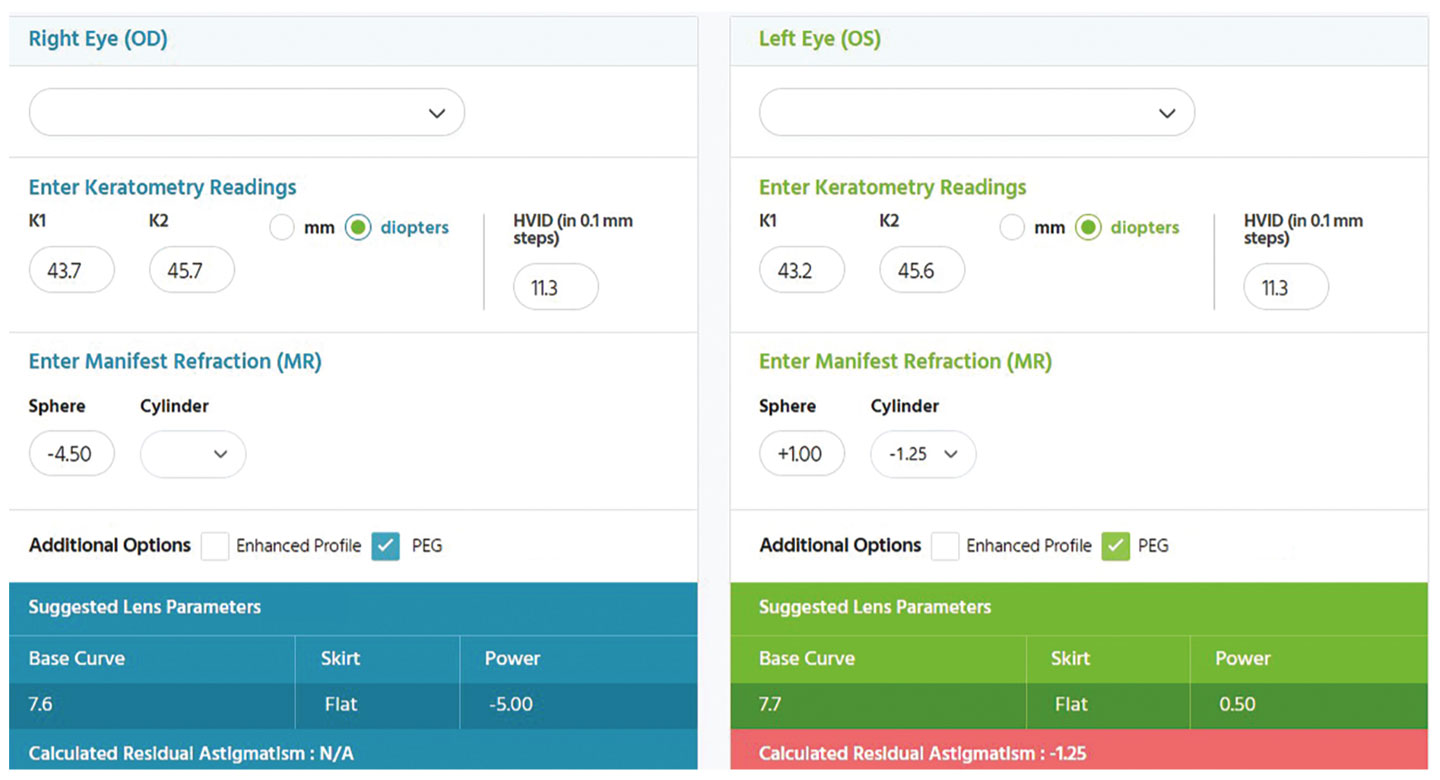
At the dispensing visit, the lenses fit well with full coverage, slight temporal decentration, and 0.75 mm of movement OD and OS. The visual acuity improved to 20/25 OD and was stable at 20/20 OS. She wore the lenses for several weeks and returned saying that she loved the comfort and vision.
At the follow-up, the lenses still fit well (Figure 2). Despite being unable to achieve any stereopsis while wearing her prior contact lenses or glasses, the patient was able to observe forms at this visit and felt her vision was “high definition” compared to previous correction. She denied any diplopia symptoms. Upon lens removal, there was no impression ring or corneal staining observed. The lens prescription was finalized, a year’s supply of lenses was ordered, and the patient left ecstatic about her vision and comfort.

This case highlights several concepts to keep in mind when considering hybrid lenses for patients. First, any patient with anisometropia and antimetropia may benefit from a contact lens. Second, patients with calculated residual astigmatism in corneal or hybrid lenses may still experience success with lens wear. We counseled this patient on the potential risk, but ultimately it was not an issue. Finally, just because a patient wears prism in spectacles, that doesn’t mean they cannot wear contact lenses. The prism can be incorporated into over-glasses, if needed.
The authors would like to acknowledge Felicia Chisesi, Illinois College of Optometry class of 2027, for her contributions to this piece.