


The International Forum for Scleral Lens Research (IFSLR) 2026 brought together clinicians and researchers from around the world to discuss the evolving role of scleral lenses (SLs) in modern eye care. This year’s meeting highlighted global prescribing trends, emerging clinical applications, and advances in optical technology, reflecting both the maturation of SL practice and continued innovation within the field.
Session 1: Global Trends in SL Fitting and Research
The first session examined worldwide SL prescribing trends and explored factors influencing access to SL care. Presentations focused on regional differences in adoption, practice-based fitting outcomes, and large-scale survey data describing contemporary prescribing patterns.
Bo Lauenborg, from Aarhus, Denmark, provided an overview of the Scandinavian SL landscape. Denmark has approximately 2,200 optometrists, many of whom receive training in SL fitting, and patients often benefit from support through national health care systems. Similar reimbursement structures exist in Norway, whereas Sweden and Finland have more limited support, contributing to lower levels of SL utilization in some regions (Figure 1).

Across Scandinavia, optometry is a relatively young university-based profession, and many practitioners continue to identify primarily as opticians. In addition, the predominance of corporately structured practices and limited involvement in ocular disease management may restrict opportunities for specialty lens prescribing. As a result, SL care is often concentrated within hospital-based settings, creating additional barriers to access.
Korine van Dijk presented data from Visser Contactlenzen in the Netherlands, one of the world’s largest specialty contact lens practices. Analysis of more than 27,000 SL fits demonstrated that keratoconus remains the most common indication, accounting for 55% of cases. The practice has also observed a trend toward relatively smaller SL diameters and increased use of toric landing zone designs. Notably, the group reported an average of only 1.2 to 1.3 lenses required per successful fit,1 highlighting the efficiency that can be achieved through extensive clinician training, standardized fitting protocols, and incorporation of advanced fitting technologies.
Muriel Schornack, OD, from the Mayo Clinic, presented findings from the latest Scleral Lenses in Current Ophthalmic Practice Evaluation (SCOPE) survey, an international study conducted in 2015, 2020, and 2025.2,3 The 2025 survey, pending publication, included 739 respondents from 60 countries and represented an estimated 462,272 SL fits. Corneal irregularity remained the primary indication for SL wear, accounting for 76% of fits, followed by ocular surface disease (17%) and refractive error correction (7%). SLs have now surpassed corneal GP lenses as the preferred modality for fitting irregular corneas, with 446 respondents ranking SLs as their first-line option compared with 99 for corneal GP lenses. Lens designs continue to trend toward greater customization, with 63% of prescribed lenses measuring at least 16 mm in diameter and landing zone designs consisting of 49% toric, 27% spherical, 17% quadrant-specific, and 7% fully custom configurations. Recommended care regimens included hydrogen peroxide–based systems (48%) and multipurpose GP solutions (39%), while preservative-free saline remained the dominant filling solution.
Collectively, these presentations illustrated the continued growth of SL prescribing worldwide while highlighting the important roles of education, health care infrastructure, reimbursement, and clinical training in determining patient access. Although many of the early pioneers of modern SL practice originated outside the United States, the United States currently remains the largest SL market and continues to lead much of the contemporary research activity in the field.
Session 2: Research on the SL Impact on Health and Disease
The second session focused on the role of SLs in managing ocular disease and improving patient outcomes. Presentations addressed ocular cicatricial pemphigoid (OCP) emerging therapeutic applications involving losartan and new multicenter data evaluating adverse events in SL wearers.
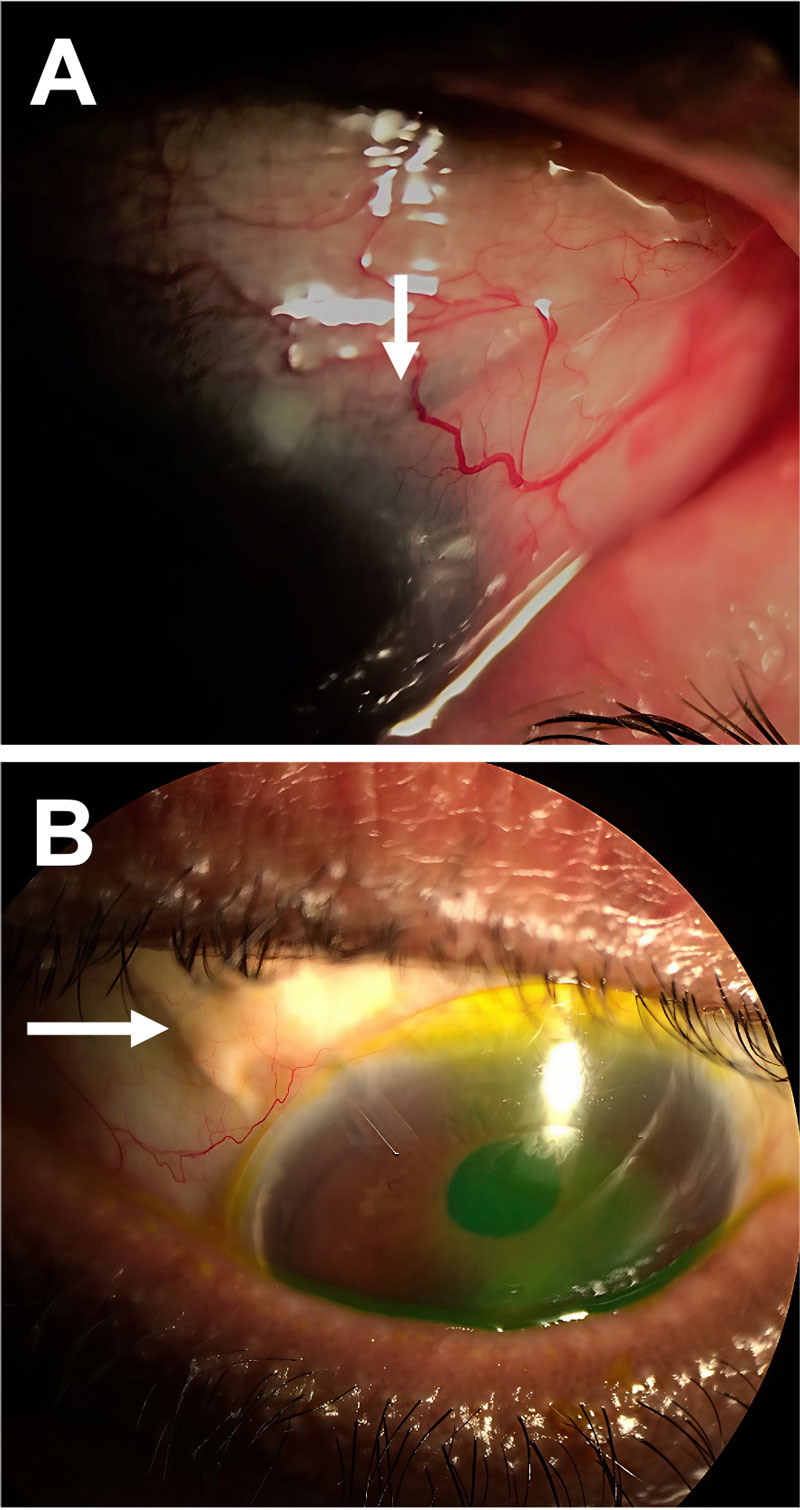
Boris Severinsky, OD, from Emory University, discussed the use of SLs in OCP, a chronic autoimmune disease characterized by progressive conjunctival scarring and ocular surface damage. OCP is estimated to affect between 1 in 12,000 and 1 in 60,000 individuals and occurs more frequently in women over 55 years of age.2 Progressive inflammation can lead to conjunctival fibrosis, keratinization, symblepharon, entropion, trichiasis, corneal scarring, and vision loss.
Dr. Severinsky reviewed outcomes from 20 OCP patients (36 eyes) fitted with SLs between 2018 and 2022.3 The primary goal of treatment was stabilization and rehabilitation of the ocular surface while optimizing systemic and topical pharmacologic management (Figure 2). Following SL initiation, 10 of 14 patients were able to reduce or discontinue topical steroid therapy, demonstrating the substantial therapeutic benefit SLs can provide in this challenging patient population.
Melanie Frogozo, OD, from Alamo Eye Care, explored the potential use of topical losartan delivered through SLs. Losartan, an angiotensin II receptor blocker, has recently emerged as a promising antifibrotic therapy due to its ability to inhibit transforming growth factor β (TGF-β)–mediated myofibroblast formation and stromal fibrosis.4 Early clinical studies using an investigational formulation are hoped to determine if topical losartan may reduce corneal haze and improve transparency following injury or surgery.
Dr. Frogozo presented clinical cases demonstrating reductions in corneal scarring following administration of preservative-free losartan within the SL fluid reservoir. These observations support the concept that SLs may serve not only as optical and protective devices but also as sustained drug delivery platforms capable of prolonging therapeutic exposure at the ocular surface.
The third presentation in this session was delivered by Maria K. Walker, OD, PhD, from the University of Houston, who presented preliminary findings from the first large multicenter study designed to evaluate adverse events associated with SL wear. The project originated in 2020 and involved collaboration among more than 40 SL practices across the United States. Data collection was completed in 2025 and included 963 SL patients from 45 clinical sites (pending publication).
The analysis identified both rare sight-threatening complications and more commonly encountered events such as midday fogging (~20% frequency), conjunctivitis (~7%), and conjunctival prolapse (~10%). The study also highlighted the challenges associated with standardized adverse event definitions and reporting across clinical settings. These data provide an important foundation for future efforts aimed at quantifying complication rates, identifying risk factors, and establishing evidence-based safety recommendations for SL practice.
Together, these presentations reinforced the expanding role of SLs as both rehabilitative and therapeutic devices. Beyond visual correction, SLs continue to demonstrate value in protecting the ocular surface, supporting disease management, and potentially enhancing delivery of emerging treatments.
Session 3: Integrating HOA Into Research and Clinical Care
The final session focused on higher-order aberrations (HOAs) and their growing relevance to both clinical practice and SL research. Presentations by Jason Marsack, PhD; Christine Sindt, OD; and John Gelles, OD, highlighted the scientific rationale, clinical outcomes, and practical considerations associated with wavefront-guided SL technology.
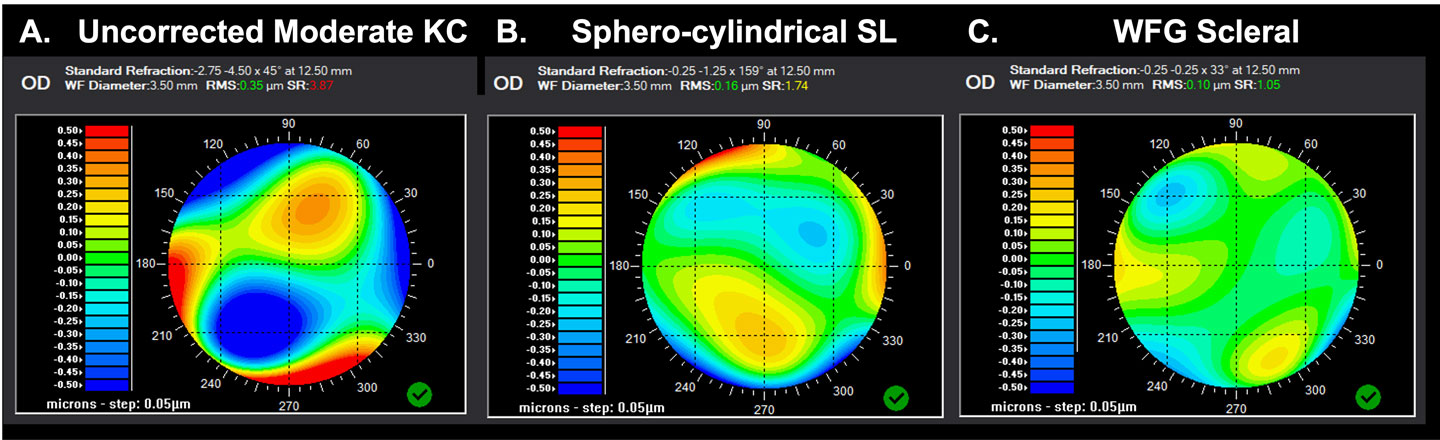
A central theme of the session was that HOAs should be viewed as a continuation of refractive error correction rather than as a fundamentally separate optical problem. While conventional refraction routinely addresses sphere and cylinder, residual visual limitations often persist because HOAs are neither routinely measured nor corrected.5,6 This issue is particularly relevant in patients who have irregular corneas, where significant optical distortions may remain even after an SL successfully neutralizes anterior corneal irregularity.
Clinical examples demonstrated that patients who have keratoconus can achieve visual acuities of 20/25 or better with conventionally fitted SLs while still experiencing visual symptoms attributable to elevated HOAs (Figure 3). Wavefront-guided SLs were presented as a patient-specific approach to addressing these residual aberrations. Studies have reported reductions in HOA magnitude of approximately 40% to 60%, with many patients achieving improvements of 1 or more lines of visual acuity.5-7 Although not every patient experiences measurable gains in acuity, subjective improvements in visual quality are commonly reported.
The presenters also emphasized that optical performance is influenced by a dynamic interaction among the tear film, blinking patterns, pupil size, lens stability, and neural adaptation. Patients may require several weeks to fully adapt to wavefront-guided corrections, underscoring the importance of appropriate patient counseling and follow-up. Aberrometry was highlighted as a valuable clinical tool not only for lens design but also for understanding patient complaints related to night vision, fluctuating vision, and visual quality under real-world conditions.
Overall, the session demonstrated that wavefront-guided SL technology has progressed from a research concept to a clinically viable option for selected patients. When combined with stable SL fitting, HOA correction offers a promising pathway for further enhancing visual outcomes in individuals who have irregular corneas.
Conclusion
The 3 sessions of IFSLR 2026 highlighted the expanding role of SLs across contemporary eye care. From global prescribing trends and health care access to disease management, therapeutic drug delivery, safety outcomes, and advanced optical correction, the meeting demonstrated both the maturity of SL practice and the substantial opportunities that remain for future innovation. Continued collaboration among clinicians, researchers, industry partners, and educators will be essential for advancing patient access, improving outcomes, and furthering SL adoption in the ophthalmic community.
Acknowledgement: The authors would like to acknowledge the SL researchers and clinicians who presented at the 9th annual IFSLR and provided content for this article. Support for the 9th IFSLR was provided by Bausch Health, CooperVision, Contamac, Valley Contax, and Visionary Optics. We appreciate the educational support from our media partners, Conexiant and the Global Specialty Lens Symposium, as well as our educational partner, the Scleral Lens Education Society.

References
1. van Ooik DJ, Soeters N, Krijgh WAC, Visser ES. Scleral lens prescribing trends in a large specialty contact lens practice in the Netherlands. Cont Lens Anterior Eye. 2025;48(5):102426. doi:10.1016/j.clae.2025.102426
2. Branisteanu DC, Stoleriu G, Branisteanu DE, et al. Ocular cicatricial pemphigoid (Review). Exp Ther Med.2020;20(4):3379-3382.doi:10.3892/etm.2020.8972
3. Severinsky B, Chambers S, Shafi A, Behshad S, Kim J. Scleral lens use in the management of ocular cicatricial pemphigoid. Eye Contact Lens. 2025;51(4):201-205. doi:10.1097/ICL.0000000000001172
4. Abdelghaffar M, Güell JL, Moura-Coelho N. Topical losartan ophthalmic drops - a review of corneal wound healing and topical losartan for managing corneal haze and potential future indications. Graefes Arch Clin Exp Ophthalmol. 2025;263(4):925-934. doi:10.1007/s00417-024-06710-85
5. Marsack JD, Ravikumar A, Nguyen C, et al. Wavefront-guided scleral lens correction in keratoconus. Optom Vis Sci. 2014;91(10):1221-1230. doi:10.1097/OPX.0000000000000275
6. Gelles JD, Su B, Kelly D, et al. Visual improvement with wavefront-guided scleral lenses for irregular corneal astigmatism. Eye Contact Lens. 2024;51(2):58-64. doi:10.1097/ICL.0000000000001152
7. Hastings GD, Applegate RA, Nguyen LC, Kauffman MJ, Hemmati RT, Marsack JD. Comparison of wavefront-guided and best conventional scleral lenses after habituation in eyes with corneal ectasia. Optom Vis Sci. 2019;96(4):238-247. doi:10.1097/OPX.0000000000001365